Our Created Ear
“The hearing ear and the seeing eye, the Lord has made them both”
Proverbs 20:12
Hi Men,
I pray that in the midst of everything happening around us, you are finding your peace where Jesus told us it would be found — “in” Him.
“……. In Me you may have peace. In the world you have tribulation, but take courage; I have overcome the world.” – John 16:33
As we all know, today marks the 25th anniversary of 9/11. The horror of that day, and the evil we still see in places like North Korea, Nigeria, Iran, etc should grieve us, but it should not surprise us. We still live in a fallen creation, scarred by sin and awaiting Christ’s final restoration.
I came across the following short devotional in the Evidence Bible earlier this week. As you read it, I think you’ll understand why I included it today.
A fallen creation. A magnificent doe stands with its fawn and drinks in the cool water from a mountain stream. The sun sparkles off the dew on deep green leaves of native tree branches. The mother gently caresses her offspring as it begins to also drink from the brook. The scene is one of incredible serenity … the picture of innocence. What more could epitomize the beauty of God’s creation?
Suddenly a mountain lion leaps from a tree and digs its sharp claws deeply into the mother’s neck, dragging the helpless creature to the ground. As it holds its terrified prey in a death grip, its powerful jaws bite into the jugular vein, turning the mountain stream crimson with the creature’s blood.
It is reassuring to know this is not the way God planned it in the beginning. Animals were not created to devour each other; they were created to be vegetarian (Gen. 1:29,30). The original creation was “good” and was not filled with violence and bloodshed. As a result of Adam’s sin, the perfect creation was cursed and death was introduced into the world (Rom. 8:20–23). The day will come when the entire creation will be delivered from the “bondage of corruption,” and there will be no more curse. In the new heaven and earth, “the wolf and the lamb shall feed together, the lion shall eat straw like the ox… They shall not hurt nor destroy in all My holy mountain” (Isa. 65:25). See also Isa. 11:6–9.
PHOTO ABOVE
I recently listened to Dr. James Tour, a synthetic chemist and nanotechnology scientist at Rice University, and one short section stopped me in my tracks.
Tour says most of us see a leaf, an eye, or a mosquito and rarely think about the staggering molecular machinery behind them. He sees the intricate engineering and says, “God, You’re amazing.”
Then he turns to hearing:
Sound begins as nothing more than pressure waves moving through the air. Your ear captures those waves, converts them into signals, and your brain recognizes a voice, music, thunder or a grandchild’s laughter.
“God, You’re amazing.”
Listen to a few minutes of his amazing talk, (YouTube, starting @ min 5:02)
So this week, let’s take a closer look at something most of us have carried around our entire lives without giving much thought to: the human ear.
I could have listed 25 jaw-dropping facts about it. Here are just eight that may leave you saying, “God, You’re amazing!”
- Sound is not what you think it is. What travels across the room is a series of pressure waves in the air. Your ear captures those waves and converts them through mechanical, hydraulic, chemical, and electrical steps into nerve signals. Your brain then gives you the experience we call sound. James Tour’s point is astonishing: outside your head is moving air; inside your head, somehow, you hear a voice, music, thunder—or your grandchild laughing.
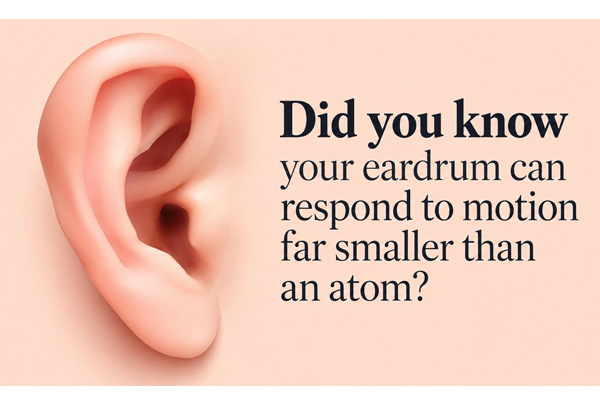
- Your eardrum can detect movements smaller than an atom. At the threshold of human hearing, the eardrum can move on the order of a picometer—roughly 1/100 the diameter of a hydrogen atom. Think about that: God designed a membrane in your head sensitive to motion far smaller than anything your eye could ever see.
- The three smallest bones in your body form an engineered transmission system. The malleus, incus, and stapes—hammer, anvil, and stirrup—take tiny movements of the eardrum and efficiently transfer them into the fluid-filled inner ear. The stapes itself is only about 3 millimeters long. Yet if this miniature mechanical system did not work properly, much of the sound energy would never reach the cochlea.
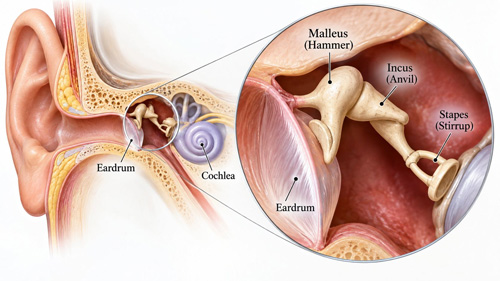
- Your cochlea is a living frequency analyzer. The tiny spiral cochlea separates incoming sound according to pitch before the brain ever interprets it. High frequencies activate one region; low frequencies another. A piano chord arrives as one pressure wave, yet this tiny structure mechanically sorts its individual frequencies almost instantly.
- About 15,500 microscopic sensory cells turn motion into electricity. Inside each cochlea are specialized hair cells with tiny stereocilia. When fluid movement bends them, microscopic channels open and mechanical vibration is converted into an electrochemical signal that can travel to the brain. Air movement has now become neural information.
- Your inner ear contains its own active amplifier. Thousands of outer hair cells actually change shape in response to electrical signals. They contract and elongate, feeding energy back into the cochlea and sharpening your hearing. These are not passive wires—they are microscopic living motors operating inside your head.
- A healthy ear can actually make sound. The inner ear produces faint sounds called otoacoustic emissions. They travel backward through the middle ear and can be measured with a tiny microphone in the ear canal. Doctors can use them to test the hearing of newborn babies. Your ear doesn’t merely receive sound—it can generate measurable sound of its own.
- Your brain can compare the two ears within millionths of a second. To locate where a sound came from, your auditory system compares when it reached each ear. Humans can detect timing differences on the order of 10 microseconds—ten millionths of a second. Somehow your brain continuously performs that calculation while you walk around having a conversation and never consciously think about it.
Men, we call this little organ an “ear.” But the deeper we look, the harder it becomes to dismiss it as merely ordinary. The hearing ear is an astonishing integration of acoustics, mechanics, fluid dynamics, chemistry, electricity, and information—and Scripture tells us plainly who made it.
“He who planted the ear, does He not hear?
He who formed the eye, does He not see?”
Psalm 94:9
IN YOUR OWN BACKYARD

What puts a smile on Grandpa’s face?
Moving dirt in Vegas… and spreading the Gospel in Carson City
When my 5 year grandson Ezra is visiting, I put him to work reshaping the sand pile that he, his brother, and cousins absolutely love. Back home in northern Nevada, he has another assignment: handing out Jesus bracelets. My daughter-in-law told me he loves giving them to people and saying, “Jesus loves you.” When she picked him up from school Wednesday, apparently everyone had one on!
Nothing excites this Grandpa more than seeing a grandson already getting a taste of the Great Commission, one little bracelet at a time. By the way, he has a cast on the other arm…… he broke his arm having too much fun on the “monkey bars!”
Here is the package the Jesus Bracelets came in

“Go, therefore, and make disciples of all the nations…” Matthew 28:19
May Jesus bless you profoundly,
Dan
———————-
CORRECTION FROM LAST WEEK….
Last week, I shared the quote below as though it came from C.S. Lewis’s, The Screwtape Letters. It did not. A friend in Texas who is part of a C.S. Lewis Facebook group brought this to my attention. It is a great and thought-provoking quote, but it should not be attributed to Lewis.
My dear Wormwood,
Be sure that the patient remains completely fixated on politics. Arguments, political gossip, and obsessing on the faults of people they have never met serves as an excellent distraction from advancing in personal virtue, character, and the things the patient can control. Make sure to keep the patient in a constant state of angst, frustration, and general disdain towards the rest of the human race in order to avoid any kind of charity or inner peace from further developing. Ensure the patient continues to believe that the problem is “out there” in the “broken system” rather than recognizing there is a problem with himself.
Keep up the good work,
Uncle Screwtape
Zion Boot Camp
December 4-6, 2026

Hi Men:
As mentioned above, today marks 25 years since September 11, 2001 — a sobering reminder of just how quickly life can change:
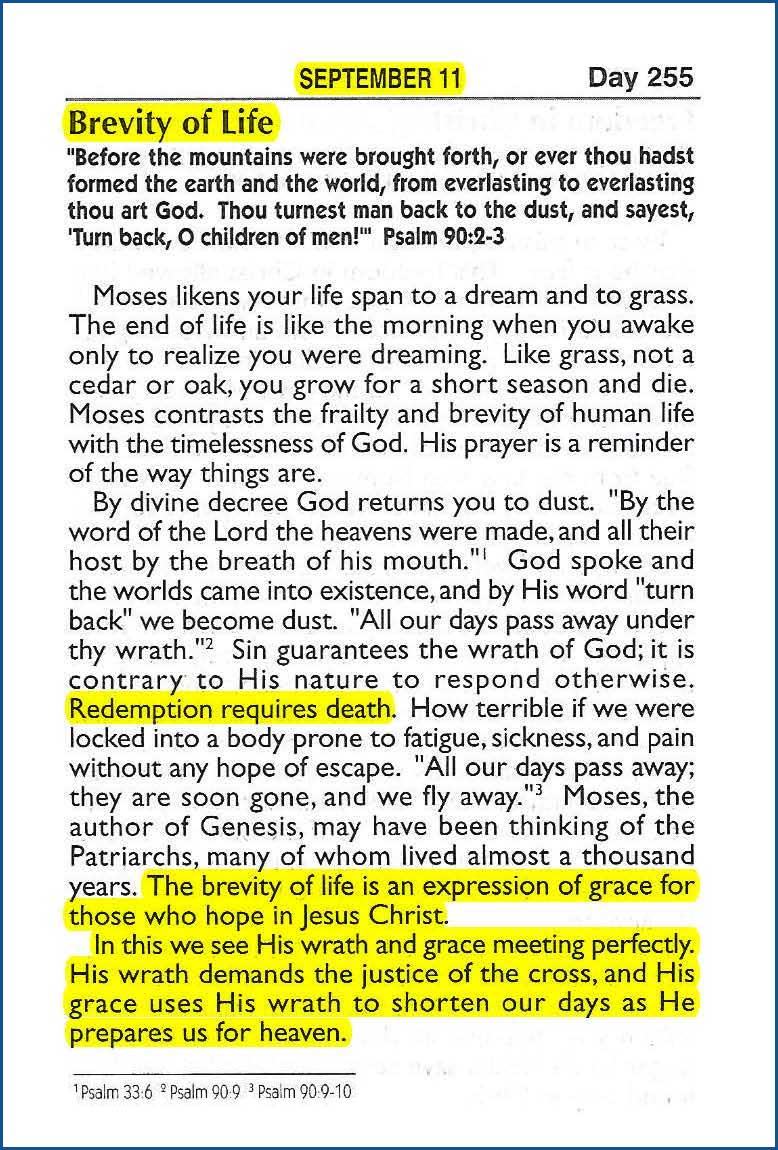
“The brevity of life is an expression of grace for those who hope in Jesus Christ.”
Men, none of us is promised tomorrow. Are we living today for what will matter in eternity?
“So teach us to number our days, that we may present to You a heart of wisdom.”
Psalm 90:12
Brevity of Life – Day 255 Blue Book
The purpose of these devotionals is to help you think Biblically
Solomon said, “As a man thinks, so is he”
DALLAS CONFERENCE 2026
Men, make some time this weekend to listen to Winston Parker’s message, “Hope and Distraction.” Amazing things to reflect on and apply to our life.
Here are 5 thoughts that grabbed me:
- “A professing Christian that doesn’t fear God doesn’t have a sustaining hope in God.” Winston connects our fear of God with where we have placed our hope. That is a statement worth stopping over.
- Is your busyness really an attempt to stay in control? Phones, computers, online sites, news, texts—and today, AI. Winston warns that our constant need to know and manage everything can rob us of peaceful fellowship with Christ.
- “Are you going to be okay today?” Winston says he has asked anxious men that question many times—and has never had one say no. God gives us enough grace for today. He does not give us tomorrow’s grace today.
- Give your life to people, not things. Winston calls investing in another person the antidote to selfishness. When we genuinely give ourselves to another man for his good, we are living out discipleship and the Great Commission.
- “The issue is not time; it’s priorities.” There are 168 hours in a week—can we give some of them to waiting and listening prayer? Winston points us to Psalm 62:5: “My soul, wait in silence for God only, for my hope is from Him.”
There is much more in Winston’s message than these five thoughts. I think you’ll find it convicting, practical, and especially timely for men who are constantly battling busyness, distraction, and the illusion of control.
Listen to Winston’s Message Here
The world measures success by numbers. God measures faithfulness by obedience.
Are you trying to produce visible results, or simply obey what God has asked you to do?
Now read this remarkable example from The Voice of the Martyrs magazine. A powerful reminder that what looks like failure to us may look very different from God’s perspective.
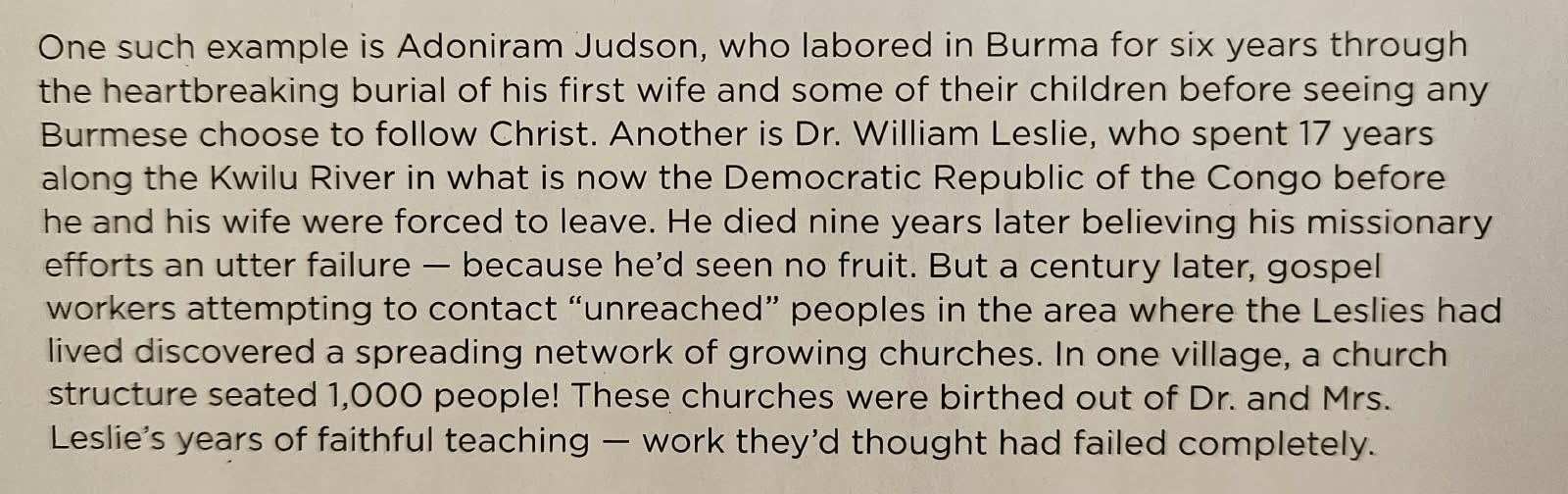
CLICK Image to enlarge

Fearing Man
by Mitch Hershey | Sep 1, 2026 | Articles, and Mentors Corner |
“I have sinned… because I feared the people and obeyed their voice.”
1 Samuel 15:24
Men, Saul did not disobey God because he misunderstood the command. He disobeyed because he feared people more than he feared God. How often do we do the same thing?
Read This Great Article — ( 2 min read.)
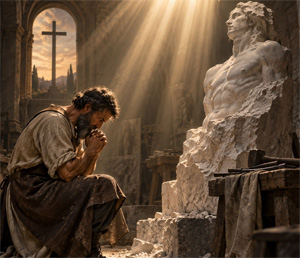
Michelangelo (1475–1564)
TO THE SUPREME BEING
Translated from the Italian by William Wordsworth
The prayers I make will then be sweet indeed,
If Thou the spirit give by which I pray:
My unassisted heart is barren clay,
Which of its native self can nothing feed:
Of good and pious works Thou art the seed,
Which quickens only where Thou say’st it may;
Unless Thou show to us Thine own true way,
No man can find it: Father! Thou must lead.
Do Thou, then, breathe those thoughts into my mind
By which such virtue may in me be bred
That in Thy holy footsteps I may tread;
The fetters of my tongue do Thou unbind,
That I may have the power to sing of Thee,
And sound Thy praises everlastingly.
A.W. Tozer was particularly struck by Michelangelo’s confession: “My unassisted heart is barren clay.” Here was one of history’s greatest artists, a man capable of creating some of the most magnificent works ever produced, acknowledging that spiritually, left to himself, he could produce nothing. God must give the desire, God must show the way, and God must lead. Michelangelo saw himself as the clay—and God as the true Artist.
9/11
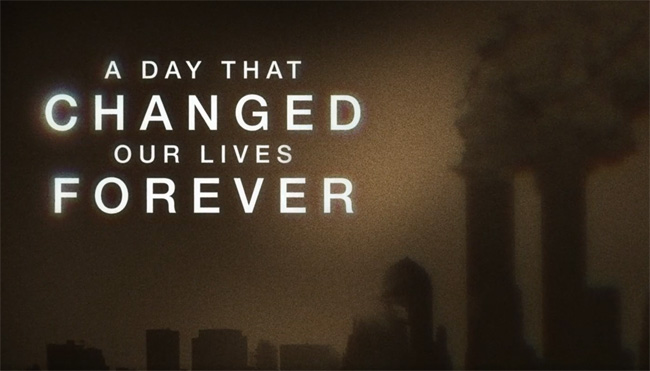
Twenty-five years after 9/11, four survivors share their harrowing stories. See how gut instinct, split-second decisions, and desperate prayers helped them face the unthinkable. Join Franklin Graham as he hosts this gripping anniversary special and be inspired by firsthand accounts of God’s power to redeem from the rubble.
BillyGraham.org/TV-Specials/A-Day-That-Changed-Our-Lives-Forever